
manifesto
the story
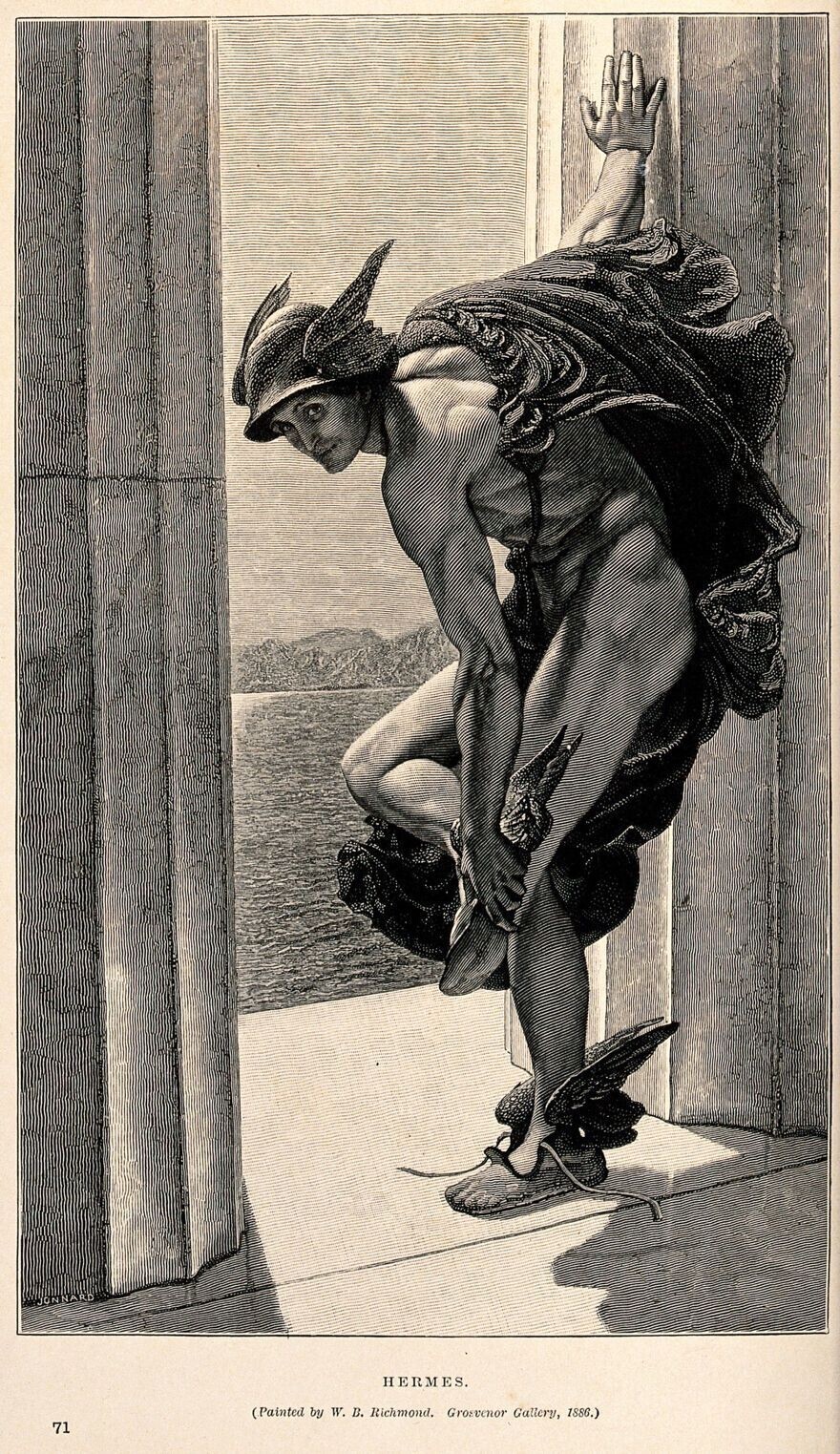
Hermes was the Greek god of both commerce and communication. With his winged sandals he traveled swiftly between the worlds of mortals and gods, transmitting ideas and guiding souls. In some tellings, Hermes is credited with inventing writing and language itself.
The Romans dubbed him Mercury, related indeed to words such as commerce, merchandise and mercenary. Mercury is also a metal notoriously liquid in room temperature: unlike water which is transparent, mercury is fully reflective. For this reflective virtue among many others, mercury was held in high symbolic regard by alchemists.
As a writing tool dedicated for curating platform-agnostic distillations of ideas, Alembic is the author's personal offering to Hermes.
in practice
wings for your ideas: write once, publish anywhere
The most durable format is the one that predates and will outlast every platform. If text is the universal interface, what better container for it than the platform-agnostic text image? Alembic doesn't need you to invite your friends on it for network effects to exist; it is built to leverage the network effects of every existing platform online. The same png exported here renders identically whether on LinkedIn, Twitter/X, Instagram, Facebook, Substack Notes, Threads, your blog or email newsletter, someone's gallery app, Pinterest, cosmos.so, are.na...
Every existing platform dedicated for ideas either requires you to post them on their walled garden ecosystem, or to write it in one place and decorate in another. Not Alembic. Once you export your image, it's yours forever to do with exactly as you please.
gamifying the editorial quest for brevity
Killing your darlings is one of the hardest things writers have to do. In Alembic, brevity is encouraged via an indirect mechanism: because the text autoresizes in the preview canvas, every word you write renders the text smaller. This provides a direct visual feedback loop for what it feels like to lose the communicative potency of your message through needless verbosity: you feel the impact of your words dilute in real-time; and every darling you kill, every filler word that doesn't serve the essence of your idea, feels satisfying to remove because the remaining words get more space to convey their dense meaning. This is the art of distilling your ideas.
unified creation space
The friction between 'writing the thing' and 'making it presentable' kills most ideas before they reach anyone. Alembic collapses that gap. Your composition IS the decoration. One workspace, one export, zero context-switching between tools built by people who've never spoken to each other.
Alembic also ensures minimal cognitive overhead for the presentation aspect: unlike in design tools like Canva or Photoshop, available visual options are constrained on purpose. Granularity and design optionality are available in the Alembic theme editor, but they are luxuries you must pay for. Bikeshedding over OpenType features, text composition or perfect color harmonies easily eats away from time that could be spent being actually inspired by ideas. In Alembic, this optionality must be redeemed with skin in the game, in the form of a subscription fee.
micro-essay as the internet-native idea medium
Longer than an aphorism, shorter than a longform essay to prevent rambling and verbosity, the micro-essay is a perfect internet-native medium for thought. Dense enough to say something real, short enough to finish quickly, visually bounded so it feels complete, and portable because it's just a png. Works as both teaser and destination. Compression as craft instead of compromise.
advances in OCR -> the legitimacy of text in images
Computer vision has advanced enough that every modern smartphone or computer has a gallery app able to read and search text in images. It is only a matter of time until this becomes a standard feature on every social media platform, and text in images will be treated with the same legitimacy as any online markup text.
analogy: a digital printing press
Before the printing press, the only way to write down ideas was by hand with a pen. If you wanted to propagate your ideas far and wide, you either had to have a strong wrist or access to scribes who would write the same things over and over again for you. Then one day, Johannes Gutenberg popularized the printing press, a means to automate the replication of ideas on paper, thereby triggering an information revolution.
A pen does the job of writing down ideas quite well; indeed the tactile process of writing by hand is most enjoyable when you have the time to enjoy it. But writing is only one thing a pen can be used for; it can be used for all kinds of visual art as well. The printing press was dedicated solely for the proliferation of the written word. Alembic serves a loosely analogous purpose: If you currently want to make an aesthetic text image, you need to use a design tool intended for all kinds of visual processing, typographic processing being only a subset of the vast options available. This demands that you spend the time developing the expertise on how the tools work, which takes away from time you could be in the writing flow. Existing tools for text processing also allow for typographic control, but the text-to-image pipeline is nonexistent or far from streamlined, and the same optionality overwhelm is baked in everywhere.
The printing press also birthed new forms of writing. No longer was the propagation of ideas reserved for monastic environments and lengthy manuscripts; it became possible to distribute standalone thoughts economically in the forms of essays or pamphlets. With Alembic, it becomes possible to do the same in the form of visually pleasing standalone text-images that maintain their appeal on any platform online (even offline!). In many respects, the format of the micro-essay image is the most fitting medium for ideas in the contemporary attention economy: unlike (old) Twitter, it lets you distribute your compressed insights anywhere, in pretty packaging, accessible even for nerfed attention spans.
Thank you for reading this manifesto. Please enjoy using Alembic; I have enjoyed every single moment of making it.
January 2026